


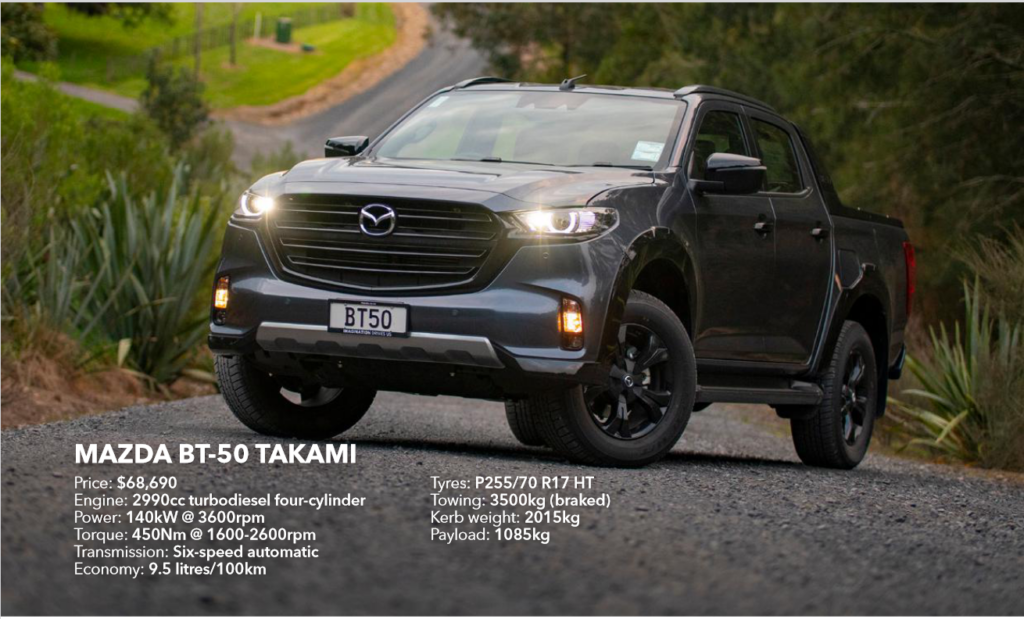
If there’s a curiously overlooked competitor in the double-cab ute segment, it’s the Mazda BT-50.
That’s been the case for several generations now. In spite of being based on the most popular ute in the business at the time, the Ford Ranger, the outgoing BT-50 was always a mild seller at best.
And even with Mazda’s best efforts, the current BT-50 is following a similar path.
To try to give. another dimension to the BT-50, Mazda has added a new flagship grade, the Takami.
Technical
On paper, the BT-50 ticks an enormous number of boxes.
It shares its platform and powertrain with the Isuzu D-Max, a vehicle synonymous with rugged durability in this field.
For a while, the BT-50 and D-Max were the only utes with a coveted five-star ANCAP safety rating.
And Mazda’s pencils proved to be sharper than Isuzu’s when it came to pricing.
This BT-50 Takami costs $68,690 (plus on-road costs, and a $2990 Clean Car fee). That’s quite competitive when you consider that the equivalent top-spec D-Max is more than $75,000, as is the 2.0-litre Ford Ranger Wildtrak.
Sold exclusively in four-wheel drive, the Takami based on the $62,190 Limited but adds a selection of creature comforts and cosmetic tweaks.
Most of these are targeted at giving the BT-50 more premium credentials, effectively the same aspirational tilt that Mazda has instilled in its other Takami variants.
Under the bonnet is a 3.0-litre turbodiesel four cylinder making 140kW of power and 450Nm of torque and, as with all other BT 50s, the Takami is sold only with a six-speed automatic gearbox.
The output figures blot the BT-50’s on-paper presence, with most of its peers pumping out 500Nm or more these days.
Still, Mazda quotes a 3500kg braked towing capacity and a 1085kg payload, the latter carried in a bed that’s 1571mm long and 1530mm wide (1120mm between the wheelarches).
Inside
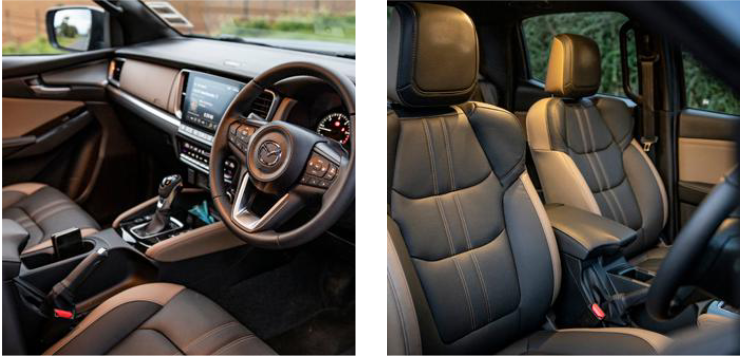
Opt for a Takami-grade BT-50, and you add khaki-coloured leather upholstery with synthetic suede panelling, and not a lot else that’s new inside the cab.
That’s in part because the standard Limited is rather loaded. In any case, both models come with heated front seats, a power-adjustable driver’s seat, an eight-speaker sound system, and a nine-inch touchscreen paired to Mazda’s latest software (it can be a little finnicky, but it’s grand once you’re used to it).
Although the dark brown leather appointments are attractive, it’s hard to ignore that there’s still plenty of hard-touch surfaces across the BT-50’s cabin.
Soft-touch surfaces could have been more prolific to further the feeling of quality and to make drivers’ forearms more comfortable when placed on the sills than they are on this hard plastic.
These additions aid an already handsomely styled and generously equipped cabin. Dual-zone climate control with rear-seat vents, satnav, Apple CarPlay, Android Auto, and a leather steering wheel are all standard.
Credit to Mazda for the full suite of passive and active safety tech that’s standard across its full range. This means all models including the Takami get engine stop and go radar cruise control, autonomous emergency braking, lane departure prevention and warning.
Outside
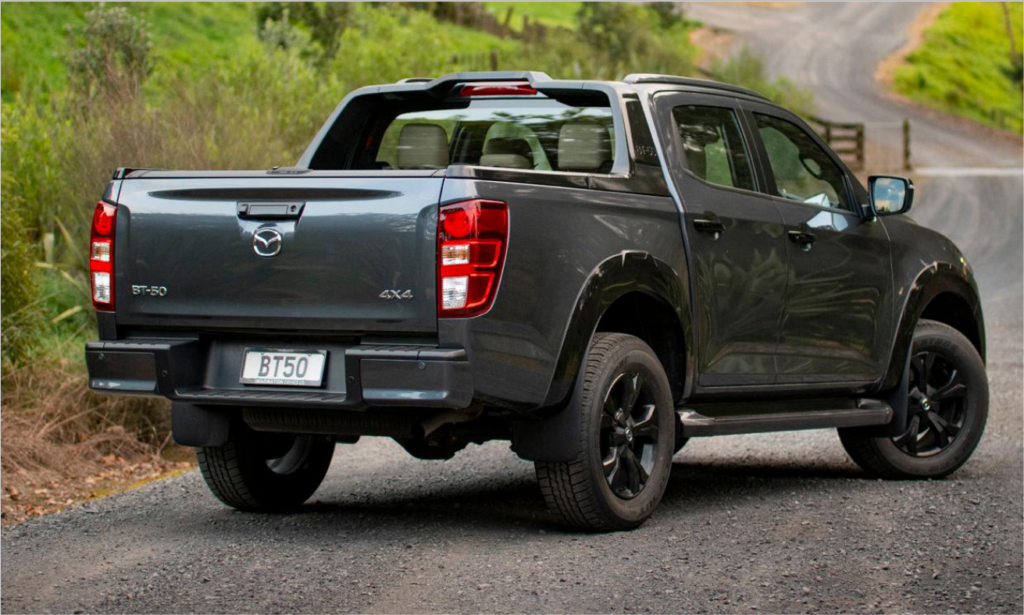
Historically, exterior styling has been one of the BT-50’s central problems, with views that the last BT-50 struggled in the showroom because its contours and curves were too ‘feminine’ for the pie-eating tradie audience.
The new model is a bit bolder and staunch looking than the last, adopting a bigger is better version of Mazda’s corporate face.
The Takami’s tweaks can be spotted a mile away, with a more athletic trim level than the likes of the Limited. Dark grey highlights feature extensively, covering the roof rails, side steps, and bash plate.
The grille, wing mirror covers, 18-inch wheels, fender flares, and sports bar feature a coat of black.
The most functional of the Takami’s exterior add-ons is its new retractable roller lid and liner, making items in the bed just that little bit more private.
The drive
Few of the Takami’s changes alter the BT-50’s driving habits, most of which point to a ute with above average refinement and usability.
Arguably, the only tweak that could make a change are the improvements Mazda says it’s made to the lane keep assist, lane departure warning, lane departure prevention, and emergency lane keep systems.
We didn’t notice much in the way of radical change, although the model’s lane keep assist did feel much more subtle than in other Mazdas sampled.
Other than that, the Takami drives like other BT-50s drive. Its ride and handling characteristics (anchored by double-wishbone front suspension and leaf spring rear) make for planted and predictable cornering, with its damping being on the firmer side relative to the competition.
The 3.0-litre powertrain is more capable than its numbers would indicate, feeling no less capable in the overtaking and acceleration stakes than most of its rivals.
Granted, we didn’t do any towing during our time with the Takami, so we can’t offer any views on whether the torque deficit means tangible losses when lugging boats and the like.
Unfortunately for the Mazda, our test of it came immediately after back-to-back loans of the new Ranger.
The comparison underlined how much louder the Mazda and Isuzu 3.0-litre is, both when it comes to start-up, idle, and at motorway speeds.
Our view
The BT-50 remains a solid, good value bet in the ute segment, with the current model undoubtedly being the best the brand has ever produced.
Adding the Takami to the line-up is mostly successful, coming as the market continues to have thirst for utes that are more refined and comfortable.
Mazda BT-50 Takami
Price: $68,690 Engine: 2990cc turbodiesel four-cylinder Power: 140kW @ 3600rpm Torque: 450Nm @ 1600-2600rpm Transmission: six-speed automatic Economy: 9.5 litres/100km Tyres: P255/70 R17 HT Towing: 3500kg (braked) Kerb weight: 2015kg Payload: 1085kg